
Diepoldsau Education Center
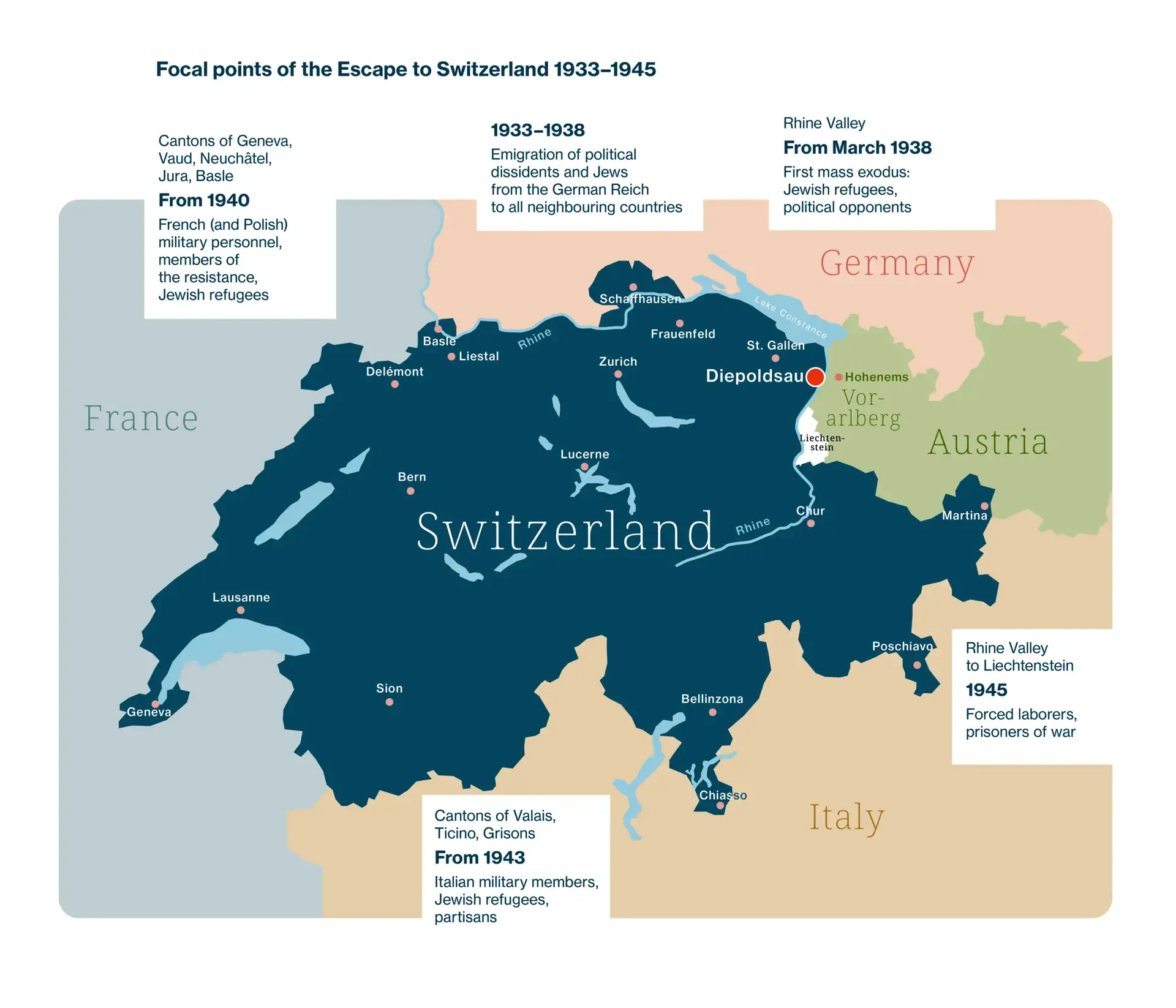
Immediately after seizing power in 1933, the Nazis in Germany began persecuting their political opponents and the Jewish people. During World War II (1939−1945), they radicalized their persecution measures into a policy of extermination, claiming millions of victims. Tens of thousands of refugees sought protection in Switzerland from persecution or war at that time. The transnational Education Center illustrates Switzerland’s policy towards refugees and what transpired at its borders between 1933 and 1945. It is being established in the border region between Diepoldsau, Switzerland, and Hohenems, Austria. The Education Center focuses on events on both sides of Switzerland’s borders with Germany, Austria, Liechtenstein, France, and Italy.
Crossing the Border: A Matter of Life and Death
In 1938, with the “Anschluss” of Austria to the German Reich and the “Kristallnacht”, the National Socialists began the violent expulsion of the Jewish population. In 1939, the regime used the outbreak of war to systematically murder people with disabilities. From 1941, the regime’s goal was to murder all Jews within the National Socialist sphere of influence. It’s absolute will to annihilate also targeted other groups defined as inferior or dangerous. For the persecuted, crossing into the safe haven of Switzerland was a matter of life and death.
The rules for admitting or rejecting persecuted people were determined in Switzerland’s political centre, the capital Bern. Following the “Anschluss” in 1938, when the first mass exodus towards the Swiss border occurred in the summer, the authorities decided to close the border. They punished those who helped refugees escape and demanded antisemitic measures such as stamping the passports of German Jews with a “J”. In 1942, when persecuted Jewish people attempted to flee to Switzerland to escape deportation to extermination camps, the border closure was confirmed.
This policy, which remained in place until 1944, had to be implemented by border guards, police officers, and soldiers at the national border, where dramatic scenes unfolded—sometimes before the eyes of the civilian population. How and where did the persecuted manage to reach Switzerland despite the border closure? How did the Swiss authorities and society deal with them? What happened to those who were turned away? Who helped them, who betrayed them—and why?
The Project
The events at Switzerland’s various border sections are historically and geographically contextualized in the Education Center. It highlights the different perspectives and scopes of action of authorities, refugees, border personnel, and the civilian population. Stories of persecution and escape, of refusal and assistance from all parts of Switzerland are told. In addition to St. Gallen Police Commander Paul Grüninger, the center also presents lesser-known individuals who demonstrated civil courage.
The Education Center is being established in Diepoldsau on the Swiss-Austrian border in collaboration with the Jewish Museum Hohenems. The historical sites, including the old customs building in Diepoldsau and the natural landscape along the Old Rhine, hold particular significance.
The project was initiated and initially funded by the Canton of St. Gallen. Since mid-2025, project responsibility lies with the Swiss Memorial Network, which is supported by the Federal Office of Culture.
Current Status (May 2026)
As part of the project “Remembering Together in the Rhine Valley 1938-1945,” the Jewish Museum Hohenems has developed the exhibition “Safe Haven Switzerland? Flight in the Rhine Valley.” It can be seen at Museum Prestegg in Altstätten until January 2027. Knowledge and experience from this exhibition will be incorporated into the future concept for the Education Center in Diepoldsau.
Further Information
Press release from the Canton of St. Gallen
Swiss Memorial for NS Victims: Foundations for Education and Networking Developed | sg.ch
Project presentation by the Canton of St. Gallen
Schweizer_Memorial_St.Gallen_Projektdarstellung_2024.pdf
Project page of the Jewish Museum Hohenems
Swiss Memorial | Jewish Museum Hohenems
Conference at PH St. Gallen June 2024
https://www.jm-hohenems.at/static/uploads/2024/09/Tagungsdokumentation-St.Gallen-Juni-2024-einzel.pdf
Ausstellungsprojekt «gemeinsam erinnern»
https://www.gemeinsam-erinnern.ch/de/ausstellungen/rettende-schweiz
Audio cycling route “Across the Border”
www.ueber-die-grenze.at